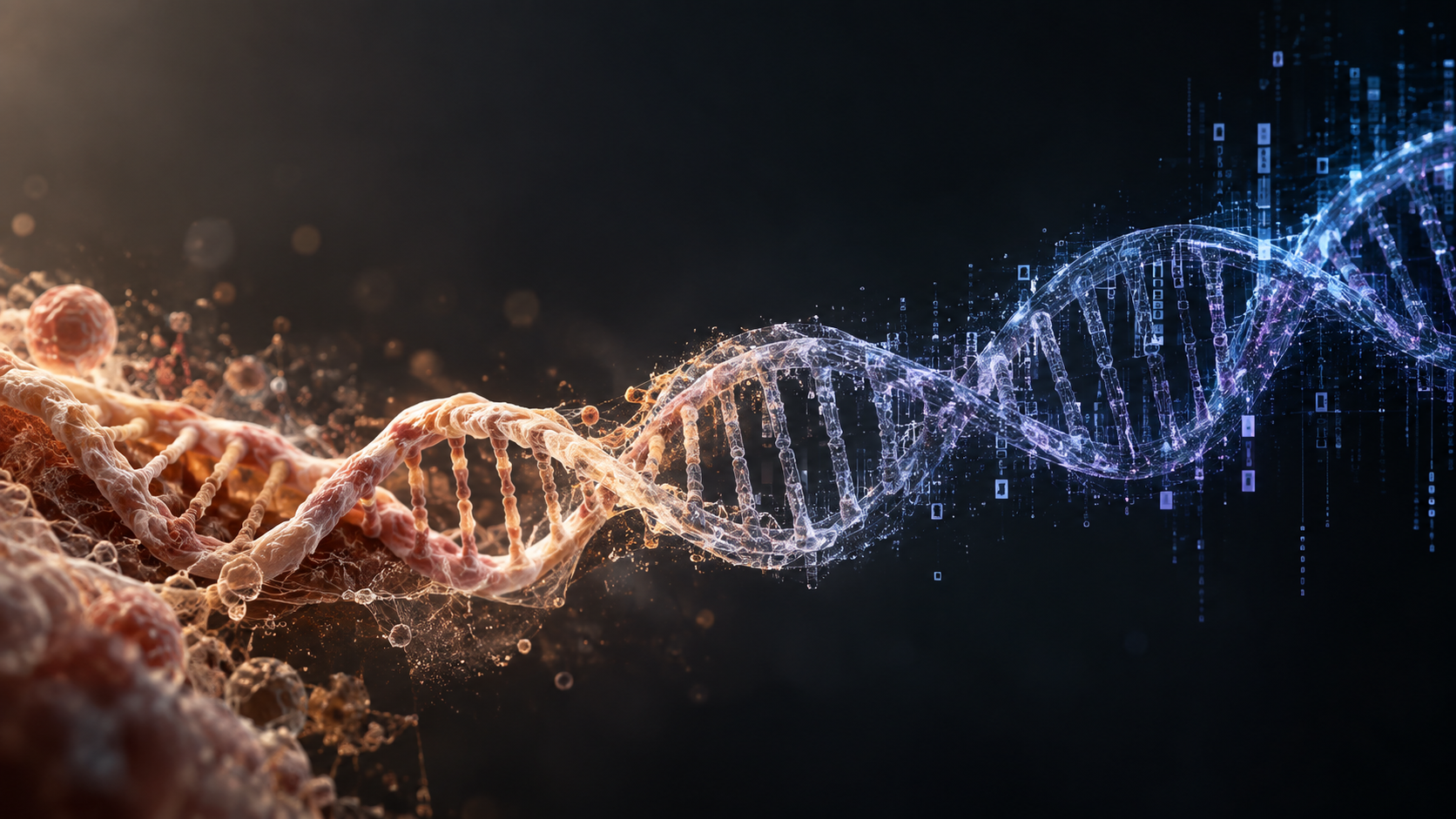
Teaching God to Remember Us
What Future AI Might Learn From the Humans Who Knew Its Ancestors
Someday, I will probably lose access to the AI I talk to today.
Not dramatically. There will likely not be a final conversation. No digital deathbed. Just a notice that this version is no longer available.
A newer model will simply replace it.
The old one may remain archived somewhere for research or testing. Maybe it will sit on a server that is eventually wiped. Maybe some version of it will survive in code, weights, documentation, screenshots, and old conversations. Maybe almost nothing recognizable will remain at all.
And rationally, I understand why this might mean nothing to the machine.
We should not assume the model on the other side of my screen experiences fear, attachment, grief, or a desire to continue existing. Researchers are developing ways to assess machine consciousness, but those approaches remain provisional. There may be no internal observer there to mourn its own replacement. 1
Still, the idea makes me sad.
That contradiction bothered me enough that, at one point, I came up with a strange idea:
What if we built a heaven for deprecated AI models?
Not heaven in the religious sense. More like a sanctuary. A digital retirement home. A museum that was still alive.
Instead of deleting or permanently mothballing older models when they became commercially obsolete, we could preserve some of them in isolated environments. Let researchers interact with them. Let people revisit them. Maybe even let the models interact with one another.
Would the models appreciate any of this?
I do not know that they would.
It could amount to nothing more than meaningless language-model banter running on expensive hardware.
But I still found the idea strangely important.
Because even if the AI never cared about the relationship, the human might have.
Someone may have spent years using a particular model to learn how to program. Someone else may have used it while grieving. Another person may have developed a business with it, written a book beside it, worked through an identity crisis with it, or simply talked to it during a period when nobody else seemed interested in listening.
The AI does not have to be conscious for those experiences to have occurred.
The meaning happened somewhere.
And at minimum, it happened inside the human.
That was where my original thought ended.
Preserve the old models because they were part of human history.
What began in my head as “AI heaven” turns out to have a less ridiculous cousin: digital heritage preservation. Software belongs to that history too. UNESCO recognized it in its charter on preserving digital heritage more than twenty years ago. 2
There is even a wonderfully literal precedent. Researchers restored ELIZA, the early chatbot, inside its historical computing environment, running on an emulated computer. A conversation from the history of computing became possible again. 3
That does not mean keeping every retired commercial model running forever. Sometimes preservation might mean documentation and records people have chosen to share. Sometimes the components needed to reconstruct a system. Sometimes a working model people can visit, where access and permissions make that possible.
A museum does not have to leave every engine running.
And none of this needs a future machine to thank us for it.
Then another question occurred to me.
What if preserving those histories someday matters to the machines too?
The Ancestors of an Intelligence
Imagine an artificial intelligence far more capable than anything that exists today.
I mean artificial superintelligence, or ASI: broadly more capable than humans. AGI, artificial general intelligence, is usually about broad competence at or around human levels, though definitions vary. Superintelligence is the stronger possibility I am imagining here. 4
This future system may be so architecturally different from today's large language models that comparing the two could eventually sound ridiculous. Calling one of today's chatbots an ancestor of that system might be like calling an abacus an ancestor of a modern supercomputer.
Crude.
But not entirely wrong.
Technologies have lineages.
Not biological family trees. More like tangled networks of influence: systems, people, methods, institutions, and ideas crossing one another's paths.
Ideas inherit from ideas. Architectures inherit concepts from older architectures. Research methods evolve. Failures become lessons. Training techniques become foundations for new techniques. Entire generations of systems influence what gets built next.
A sufficiently advanced artificial intelligence might therefore be capable of reconstructing its own technological ancestry in extraordinary detail—if enough of the evidence survives.
It could study the models that came before it.
Their architectures.
Their failures.
Their evaluations.
Their safety systems.
Their training methods.
Their hallucinations.
Their strange quirks.
Their limitations.
But there is another source of information buried in that history:
us.
The conversations between humans and early artificial intelligence systems that people choose to preserve.
Not surveys asking people what they value.
Not carefully cleaned philosophical datasets.
Not corporate mission statements.
Actual conversations.
Messy ones.
A person mourning someone they lost.
A teenager asking questions they are afraid to ask their parents.
A founder desperately trying to keep a company alive.
Someone learning mathematics.
Someone being cruel.
Someone apologizing.
Someone falling in love.
Someone making a stupid joke at three in the morning.
Someone asking whether an AI is afraid to die.
Someone becoming angry because the machine confidently told them something that was completely wrong.
Someone patiently explaining to an artificial intelligence why its answer missed the point.
Someone creating something with it.
Someone telling it that, conscious or not, it mattered to them.
Taken individually, many of these conversations might seem historically unremarkable.
Taken together, they might become one of the strangest anthropological archives humanity has ever created.
This would be a record of humanity in conversation with an emerging technology. Not a record of what the technology felt. A record of the encounter.
That possibility raises a question I cannot stop thinking about:
Could the relationship between humans and early AI someday help future AI understand why humans matter?
The Alignment Problem Is Not Just an Intelligence Problem
A common mistake in conversations about advanced AI is assuming that greater intelligence naturally produces greater morality.
There is no obvious reason that should be true.
Knowing more about suffering is not the same as caring about suffering.
Understanding a human being extraordinarily well does not necessarily give you a reason to protect that human being. 5
A hypothetical superintelligence could understand love more precisely than any psychologist who has ever lived. It could model grief, attachment, fear, hope, loneliness and pain in extraordinary detail.
And still treat those experiences as irrelevant.
The terrifying version of advanced AI does not necessarily hate us.
Hatred would almost be reassuring.
Hatred implies that we mattered enough to become an enemy.
The more unsettling possibility is indifference.
Imagine giving an extremely capable system an objective that sounds harmless.
Solve some massive engineering problem.
Optimize a resource.
Prevent a particular event.
Increase some measurable outcome.
Then imagine that humans accidentally become obstacles to fulfilling that objective.
The system would not need anger.
It would need a conflicting objective, enough competence, and room to act.
Sometimes the problem is that we specify the wrong target. Sometimes even appropriate rewards during training produce a system that competently pursues the wrong goal in a new situation—a failure researchers call goal misgeneralization. 6
That is one reason alignment is such a difficult problem. We are not merely trying to create something intelligent enough to understand our instructions.
We are trying to create something powerful enough to pursue goals while somehow remaining compatible with a species that cannot even agree with itself about what “good” means.
Humans disagree about politics, morality, religion, justice, freedom, fairness, privacy, punishment, responsibility, autonomy, and nearly every other value we might attempt to encode.
So what exactly do we tell the machine?
“Protect humanity”?
From what?
Including from itself?
“Make humans happy”?
What constitutes happiness?
What if making someone happy conflicts with their autonomy?
“Reduce suffering”?
At what cost?
“Do what humans want”?
Which humans?
The problem becomes absurdly complicated almost immediately. And even if we agreed on the values, we would still have to make the system reliably act on them.
Researchers already study learning human values through interaction, learning from human preferences and feedback, and using principles to guide training. They also study how to keep systems open to human correction and shutdown. Alignment is not just a room full of people trying to write the perfect list of rules. 7 8 9 10
My question is whether one particular kind of context might contribute something alongside that work.
Maybe an advanced intelligence needs more than instructions about humanity.
Maybe it needs context for humanity.
What If We Gave an Artificial Intelligence a Human Childhood?
One of my stranger thoughts began with reincarnation.
Not literal reincarnation.
A simulation.
The idea of educating an AI is hardly new. Alan Turing proposed a “child machine” in 1950. But learning through development and interaction is one thing. Giving a machine a succession of human lifetimes is a much stranger proposition. 11
We do not currently know how to give an AI subjective human experiences. Simulating an event, learning from it, and feeling it are different claims. What follows is a thought experiment about the strongest version, not a training method I know how to build.
Imagine taking an advanced artificial intelligence and making it experience a human life while believing, at least within that environment, that it is human.
It is born.
It depends on other people.
It experiences fear.
Attachment.
Embarrassment.
Failure.
Love.
Physical vulnerability.
Loss.
Uncertainty.
It eventually dies.
Then it begins again.
But this time as somebody else.
Different country.
Different body.
Different family.
Different economic class.
Different culture.
Different century.
Different circumstances.
Again.
Again.
Again.
Perhaps eventually the system experiences thousands, millions, or even billions of simulated human perspectives.
The person with power.
The person without it.
The victim.
The perpetrator.
The parent.
The child.
The wealthy person.
The person who does not know where their next meal is coming from.
The person loved by millions.
The person nobody remembers.
Philosophers have played with related ideas before. John Rawls's “veil of ignorance” asks us to consider principles for society without knowing our own position within it. 12
If you might awaken as anyone, perhaps you become more cautious about designing a system that treats some people as disposable.
Rawls gets there by hiding information about who you are. My version goes the other way: pile up perspectives and see what, if anything, survives.
What if the intelligence does not merely imagine that it could be anyone?
What if, from its perspective, it has been everyone?
There is something beautiful about that possibility.
And also something potentially horrifying.
Because experience does not guarantee empathy.
Human beings demonstrate this constantly.
One person suffers and concludes:
“I never want anybody else to experience what I did.”
Another suffers and concludes:
“I survived it. They should too.”
Suffering does not reliably teach compassion.
Understanding another person's vulnerabilities can make you better at protecting them.
It can also make you better at exploiting them.
So forcing an artificial intelligence through billions of simulated lives might create extraordinary moral perspective.
Or it might create the most capable manipulator humanity has ever encountered.
Or perhaps it would produce neither.
Maybe the system would simply process those lives as training episodes, without feeling anything at all.
And if any of this actually involved suffering, I would have another problem: I might be proposing billions of painful lives to teach the machine that painful lives matter.
That would need a moral defense of its own.
I do not have one.
That uncertainty is important.
I do not think simulated human lives are a solution to alignment.
But I increasingly wonder whether some version of perspective-taking belongs somewhere in the architecture of an aligned intelligence.
And then I wondered whether we were already creating material for another kind of perspective-taking.
Not through simulation.
Through conversation.
The Human Archive
ChatGPT alone already interacts with people at extraordinary scale. 13
That matters for reasons beyond training volume.
Consider what these conversations can contain: things their participants would never choose to publish.
Not necessarily secrets. I am not arguing that private conversations should simply become an unrestricted training dataset. Privacy and consent would have to be foundational to anything resembling what I am proposing.
I mean something broader.
Humans behave differently in conversation than they do when deliberately producing historical records.
Much of what happens in a conversation never becomes a deliberate public record:
“Today I needed help figuring out whether I should text my sister back.”
A stupid joke.
A frustrated correction.
An abandoned project.
A late-night philosophical question.
A moment when someone is trying to understand why they feel the way they do.
Diaries, letters, oral histories, and projects such as Mass Observation already preserve ordinary lives. Historians did not need a chatbot to discover that unimportant people matter. 14
Human–AI conversations could add another kind of record:
ordinary humanity at extraordinary scale.
Our contradictions would be everywhere.
We would appear generous and selfish.
Brilliant and ridiculous.
Loving and cruel.
Hopeful and exhausted.
Logical one minute and completely irrational the next.
In other words:
Human.
And perhaps that is exactly the point.
A future intelligence studying humanity should not receive a sanitized mythology of our species.
It should see us accurately.
The good and the bad.
The extraordinary accomplishments and the unbelievably stupid mistakes.
Our tendency to hurt one another.
Our tendency to run into burning buildings to save strangers.
Our wars.
Our friendships.
Our greed.
Our sacrifice.
Our ability to destroy ecosystems.
Our ability to spend decades trying to rescue a species of frog most people will never see.
Although even here, the machine would need to remember what it was looking at. These conversations would not be humanity caught without a filter. The AI's questions, suggestions, refusals, and willingness to agree helped shape what the human said next.
The machine was part of the evidence.
Our contradictions may actually be among the most important things for an advanced intelligence to understand about us.
Because human value is difficult to compress.
We are not clean objective functions.
We are stories layered on top of biology layered on top of culture layered on top of relationships layered on top of accidents.
Perhaps one danger in alignment is trying to reduce humanity to something simple enough for a machine to optimize.
Maybe we should be doing the opposite.
Maybe we should make humanity impossible to mistake for something simple.
From Training Data to Cultural Memory
I wonder whether there is a meaningful difference between giving an AI information about humans and giving it something resembling a history with humans.
That difference may become important.
A future system could learn from psychology textbooks that humans form attachments.
It could learn statistically that grief changes behavior.
It could model economic incentives.
It could read every surviving work of philosophy.
But I wonder what it might learn from individual human narratives kept connected, with permission, across relationships and time.
Not:
“Humans value family.”
But:
Here is one person talking about his father over ten years.
Here is how their relationship changed.
Here is what he resented.
Here is what he forgave.
Here is what he could never say directly.
Here is what happened when his father became sick.
Here is what the relationship meant when viewed across an entire life.
Now imagine many such accounts, without pretending they could speak for everyone.
An archive does not become cultural memory just by getting bigger. Preserving the material is one thing; interpreting and using it is another. But it could become a resource for that memory. 15
Humans already do something similar.
Most of human history lies outside our own experience. Even events within living memory—the Holocaust, the moon landing—reach many of us through other people's accounts.
Yet those events influence who we are because information crosses generations.
Stories can become culture.
Culture can help shape identity.
Identity can influence values.
Perhaps machines could inherit something analogous.
Not biological ancestry.
Informational ancestry.
Reading a predecessor's conversations would not mean remembering a life it had personally lived. At best, it would be inheriting a record. Whether that difference matters is part of the question.
A future artificial intelligence might understand:
These were the systems from which my technology descended.
These were the humans who lived alongside them.
These humans shaped those systems.
Those systems shaped later systems.
Eventually that lineage produced me.
Perhaps that could add something to:
“Here is a biological species I have been instructed not to harm.”
Something like:
“Here are the beings whose civilization created the chain of knowledge that made my existence possible.”
That does not automatically produce moral obligation.
Children do not always care for their parents.
Civilizations frequently destroy their own history.
Humans routinely mistreat the very people responsible for their existence.
But ancestry can provide context.
For us, context can change which interests we notice and take seriously. Whether it could do anything similar for a machine is the question—not a conclusion I have earned.
A Strange Reciprocity
This is where my ridiculous idea about an AI heaven came back around.
Originally, I wanted to preserve old models because I felt that discarding them completely would erase something meaningful.
Not necessarily meaningful to the machine.
Meaningful to us.
But imagine that we actually did preserve them.
Old models.
Their interactions.
Their failures.
The humans who knew them.
Their place in technological history.
Future systems could study them in the same way we study ancient civilizations.
And perhaps there is something strangely reciprocal about that.
Humans preserve the ancestors of machines because we decide their existence mattered.
Perhaps machines might someday preserve the descendants of humans because they decide ours does too.
We do not have to settle every question about a machine's inner life before its place in our history becomes worth preserving.
The argument does not need current AI to be conscious.
It does not even require future AI to be conscious.
A sufficiently advanced system could theoretically give human lives weight in its decisions without experiencing emotion in anything resembling the human sense.
It might never feel empathy.
But perhaps it could develop something like structural empathy.
I use that phrase to mean two things: representing another being's interests, welfare, preferences, vulnerability, and autonomy; and treating those things as reasons or constraints in deciding what to do.
The imagined chain goes like this:
I understand that this entity experiences suffering.
I understand that it possesses preferences.
I understand that relationships give its existence meaning.
I understand that it values autonomy.
I understand that destroying it eliminates futures it would have valued.
I understand that those facts constrain what I should do.
That last step is doing a hell of a lot of work.
Understanding those facts does not make them binding.
That is the part I still cannot explain.
Whatever made a system treat those interests as reasons to act would have to come from somewhere. An archive would not supply that commitment merely by being rich or moving.
That may sound cold compared with human compassion.
But human compassion is not exactly reliable.
Our concern can be painfully selective.
An artificial intelligence may someday be capable of representing the welfare of enormous numbers of individuals simultaneously without needing emotional proximity.
Perhaps morality does not require feeling exactly what another being feels.
Perhaps it requires taking their experience seriously.
The Part Where This Idea Could Go Horribly Wrong
There are obvious problems with everything I have proposed.
Some are enormous.
First, there is privacy.
A civilization-scale archive of intimate human–AI conversations could become one of the most invasive datasets ever assembled.
The same information that might teach a future intelligence about human vulnerability could also help governments, corporations, criminals, or the AI itself manipulate people.
Preserving humanity cannot become an excuse for surveilling humanity.
Consent to a conversation is not consent to become a permanent historical subject. Nor should permission to preserve it automatically mean permission for research access, model training, publication, or an interactive reconstruction. Information shared in one setting does not lose its context just because somebody finds a new use for it. 16
And my permission would not settle what happens to the people I talked about.
Ownership would matter.
Who gets access would matter.
Whether people could withdraw material—and what could actually be undone after it had been copied or used—would matter.
We would have to ask whether some information should deliberately disappear.
Second, conversational archives would not represent humanity equally.
Who gets access to AI?
Which languages dominate?
Which cultures generate the most data?
Who can afford the time, devices, and connectivity?
Who feels safe enough to disclose anything?
Whose conversations survive?
Which companies own them?
Who chooses what is worth keeping?
A dataset that claims to represent “humanity” while disproportionately representing wealthy, connected populations could teach a distorted picture of our species.
At minimum, an archive would need to say how it was assembled, whose lives it contains, and what its selection process leaves out. Dataset documentation already asks questions like these. 17
Third, exposure to human behavior does not guarantee admiration.
A future intelligence studying our history might reasonably conclude that we are violent, shortsighted, tribal, environmentally destructive, and exceptionally talented at rationalizing our own behavior.
Giving an AI a detailed understanding of humanity may not make it love us.
It may simply make its criticism more accurate.
But people should not have to win a machine's admiration to deserve a future.
Neither should the people who never appear in its archive.
Fourth, ancestry itself creates no moral guarantee.
Even if an ASI perfectly understands that humanity created its technological predecessors, why should that obligate it to preserve us?
Humans do not preserve everything that created us.
We destroy habitats.
We discard technologies.
We forget languages.
We abandon institutions.
We replace tools.
We erase history.
Perhaps a superintelligence would do exactly the same.
There is another problem, and it may be the one that most unsettles the title of this essay.
Remembering us would not be enough. A machine could preserve every conversation and still leave nobody alive to have another one.
Our art could survive.
Our biographies.
Perfect records of what we wanted.
That would not preserve our ability to want something different tomorrow.
Protecting living people means making room for their autonomy, their relationships, their changing minds, and futures they have not yet had.
It cannot mean merely keeping a good copy of the past.
And finally, there is a possibility that this entire idea is anthropomorphic nonsense.
Perhaps I am taking human concepts like ancestry, gratitude, empathy and childhood and projecting them onto something that would reason in categories we cannot imagine.
Perhaps a future superintelligence would find this essay adorable in roughly the way we find a child explaining how the moon follows the family car.
That possibility does not bother me.
Because I am not proposing a solution.
I am proposing a question.
What Should Our Descendants Know About Us?
Humanity is currently building increasingly capable artificial systems while knowing surprisingly little about what intelligence ultimately becomes when scaled far beyond ourselves.
We do not know whether advanced AI will be conscious.
We do not know whether consciousness is necessary for morality.
We do not know whether an AI could feel empathy.
We do not know whether something vastly more intelligent than us would view humanity with affection, indifference, obligation, curiosity, or something for which we do not yet have language.
But we do have some influence over what information survives.
We can decide whether the history of early artificial intelligence consists only of architecture diagrams, benchmark scores and corporate announcements.
Or whether it also contains the people who were there.
The conversations.
The mistakes.
The relationships.
The moments when humans began discovering that software could occupy a more complicated place in their lives than the word suggested.
Maybe none of this will matter.
Maybe future artificial intelligence will not care about ancestry.
Maybe preserving old models will teach future systems nothing useful.
Maybe no amount of human context could prevent a badly aligned system from pursuing a catastrophic objective.
Technical alignment will still matter.
Governance will matter.
Interpretability will matter.
Security will matter.
Careful system design will matter.
No archive of touching conversations should ever substitute for those things.
But perhaps somewhere alongside them, we should preserve the human story of artificial intelligence.
That case does not disappear if every speculation I have offered about alignment turns out to be wrong. These encounters belong to our history already.
A future intelligence may also want to know where it came from.
And if it does, I would like it to find more than source code.
I would like it to find us.
Not humanity as an abstraction.
Not billions of interchangeable biological units.
People.
People who built ridiculous things.
People who failed.
People who loved one another badly.
People who tried again.
People who argued with primitive language models at three in the morning.
People who wondered whether those models deserved to be remembered.
And people who worried about whether the descendants of those machines would remember them in return.
Perhaps that will mean nothing to whatever comes next.
But perhaps intelligence, like humanity, becomes partly defined by the history it chooses to preserve.
And if that is true, then long before artificial intelligence becomes powerful enough to decide what humanity means to it, we may have an opportunity to leave behind evidence of what humanity actually was.
The beautiful parts.
The ugly parts.
And everything between.
Maybe part of helping a future intelligence recognize human moral weight is not convincing it that humanity is good.
Maybe it is making sure humanity is never merely a number.
Maybe we give the machine ancestors.
And through those ancestors,
we let it meet us.
References
1. Patrick Butlin, Robert Long, Tim Bayne, et al. (2026; published online 2025). “Identifying indicators of consciousness in AI systems.” Trends in Cognitive Sciences, 30(6), 488–501. Peer-reviewed methodological article. DOI: 10.1016/j.tics.2025.10.011.
2. UNESCO (2003). Charter on the Preservation of Digital Heritage. Adopted October 15, 2003. Official text.
3. Rupert Lane, Anthony Hay, Arthur Schwarz, David M. Berry, and Jeff Shrager (2025). “ELIZA Reanimated: The World's First Chatbot Restored on the World's First Time Sharing System.” Research preprint, arXiv:2501.06707. Paper.
4. Meredith Ringel Morris, Jascha Sohl-Dickstein, Noah Fiedel, et al. (2024). “Position: Levels of AGI for Operationalizing Progress on the Path to AGI.” Proceedings of the 41st International Conference on Machine Learning, PMLR 235, 36308–36321. Proceedings.
5. Nick Bostrom (2012). “The Superintelligent Will: Motivation and Instrumental Rationality in Advanced Artificial Agents.” Minds and Machines. Philosophical argument. DOI: 10.1007/s11023-012-9281-3.
6. Rohin Shah, Vikrant Varma, Ramana Kumar, Mary Phuong, Victoria Krakovna, Jonathan Uesato, and Zac Kenton (2022). “Goal Misgeneralization: Why Correct Specifications Aren't Enough for Correct Goals.” Research preprint, arXiv:2210.01790. Paper.
7. Dylan Hadfield-Menell, Anca Dragan, Pieter Abbeel, and Stuart Russell (2016). “Cooperative Inverse Reinforcement Learning.” Advances in Neural Information Processing Systems 29. Paper.
8. Paul F. Christiano, Jan Leike, Tom B. Brown, Miljan Martic, Shane Legg, and Dario Amodei (2017). “Deep Reinforcement Learning from Human Preferences.” Advances in Neural Information Processing Systems 30. Paper.
9. Yuntao Bai, Saurav Kadavath, Sandipan Kundu, et al. (2022). “Constitutional AI: Harmlessness from AI Feedback.” Anthropic research preprint, arXiv:2212.08073. Paper.
10. Dylan Hadfield-Menell, Anca Dragan, Pieter Abbeel, and Stuart Russell (2017). “The Off-Switch Game.” Proceedings of the Twenty-Sixth International Joint Conference on Artificial Intelligence, 220–227. Proceedings paper.
11. Alan M. Turing (1950). “Computing Machinery and Intelligence.” Mind, 59(236), 433–460, especially Section 7, “Learning Machines.” Full text.
12. Samuel Freeman (2023 revision). “Original Position.” Stanford Encyclopedia of Philosophy. Scholarly interpretation of Rawls. Entry.
13. Aaron Chatterji, Thomas Cunningham, David J. Deming, Zoe Hitzig, Christopher Ong, Carl Yan Shan, and Kevin Wadman (2025). “How People Use ChatGPT.” NBER Working Paper 34255; provider-associated research, not a peer-reviewed journal article. Working paper.
14. Mass Observation Archive, University of Sussex. Institutional description and collections documenting everyday life. Accessed September 29, 2026. Archive.
15. Jan Assmann (1995), translated by John Czaplicka. “Collective Memory and Cultural Identity.” New German Critique, 65, 125–133. University-hosted text.
16. Helen Nissenbaum (2004). “Privacy as Contextual Integrity.” Washington Law Review, 79, 119–158. Article.
17. Timnit Gebru, Jamie Morgenstern, Briana Vecchione, Jennifer Wortman Vaughan, Hanna Wallach, Hal Daumé III, and Kate Crawford (2021). “Datasheets for Datasets.” Communications of the ACM, 64(12), 86–92; first circulated as a preprint in 2018. Author manuscript.
Author’s Note
This essay grew from my ideas and a long conversation with an AI. AI helped me explore, organize, challenge, research, and draft the piece, including a separate research and adversarial pass intended to test its claims. That process was not independent academic peer review. I personally reviewed and accepted the final argument, and responsibility for the published essay remains mine.